
CRECCOM's Community-to-Classroom Accountability Model Sparks Continental Dialogue at FLEX 2026
Updated: Jul 17

How can Africa unlock the full potential of communities to improve children's learning? That question took centre stage during Session 3D at the Africa Foundational Learning Exchange (FLEX 2026), where Malawi showcased an innovative approach that is redefining community engagement in education.
Opening the discussion, Ms Joyce Saukira, Deputy Director, Directorate of Quality Assurance Services, Ministry of Education, Malawi, highlighted a critical challenge: while community structures exist in almost every school, most engagement remains focused on governance, infrastructure and learner attendance, with limited mechanisms that directly connect community action to teaching and learning.
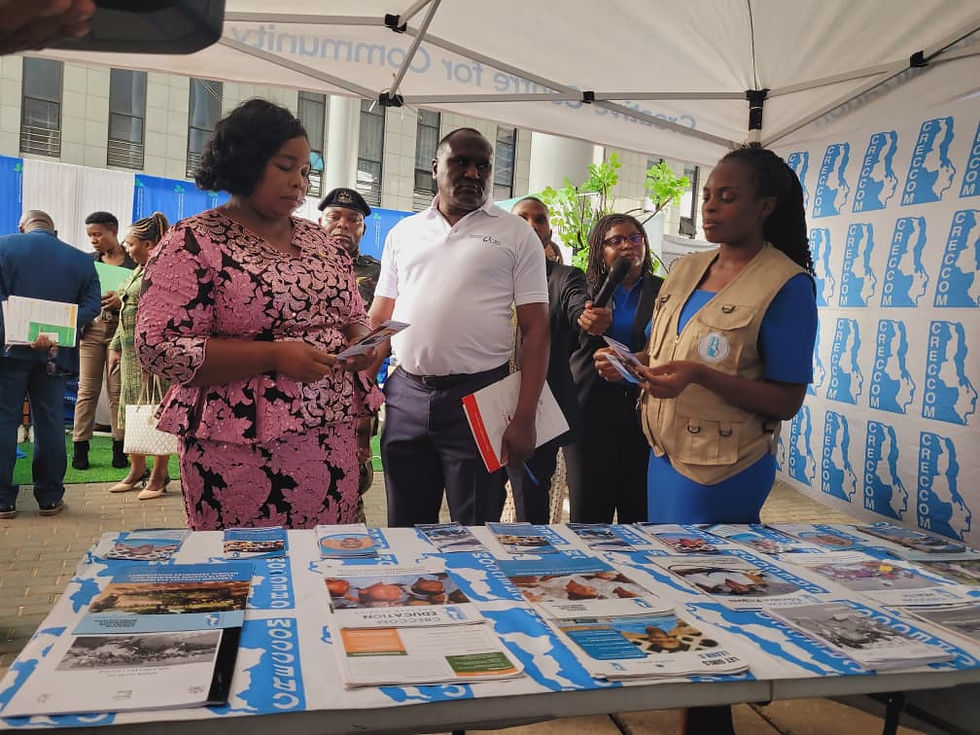
Responding to this challenge, Nephitaly Abel Benister, Programmes Manager at CRECCOM, presented the Community-to-Classroom Accountability and Support Model, an innovation being piloted in 36 schools across four education districts.
At the heart of the model are Community Education Change Agents (CECAs), who bridge schools, families and communities to ensure that parents actively support learning beyond the classroom. The model also promotes the use of learning data to drive joint school-community action, while school leaders and district education teams provide continuous coaching to sustain improvement.

In her remarks, Ms Mphatso Mary Magombo, Chief Community Development Officer, Ministry of Gender, Community Development and Social Welfare, Malawi, emphasized that existing community structures can significantly improve learning when their voices are linked to instructional decisions rather than remaining confined to school governance. By strengthening accountability between schools and communities and embedding ongoing coaching, the model is helping transform community participation into measurable learning gains.
The Malawi experience strongly resonated with presentations from Nigeria and the Sahel and Sudan, which demonstrated that community leadership is essential for sustaining learning, especially in contexts facing exclusion, conflict and other challenges. Across the session, participants agreed that stronger investment in community mobilisation and engagement is critical if Africa is to deliver foundational learning at scale.

The model received positive feedback from participants, with several commending its practical approach and calling for similar innovations to be adopted more widely across the continent. As one participant, Professor Haruna Musa, a Nigerian Academic and 12th Chancellor of Bayero University in Kano State remarked, "This is exactly the kind of approach we need."
Watch our session here: https://youtu.be/uFypfN9hmFg


Comments