
EU and Ireland Witness SP-GEAR's Growing Impact in Zomba
Updated: Aug 5
Officials from the European Union and the Embassy of Ireland spent a day traveling across Zomba District to observe how the Social Protection for Gender Empowerment and Resilience (SP-GEAR) project is empowering vulnerable households to build sustainable livelihoods through skills training, savings groups, and enterprise development.
Funded by the European Union and the Government of Ireland through UNICEF Malawi, the SP-GEAR Project complements the Government of Malawi's Social Cash Transfer Programme (Mtukula Pakhomo) by equipping beneficiary households with practical skills, financial inclusion, climate-smart agriculture, nutrition interventions, early childhood development support, social and behaviour change communication, child protection services and enterprise development.
The monitoring visit united representatives from the European Union, the Embassy of Ireland, the Ministry of Gender, the Ministry of Trade, UNICEF Malawi, CRECCOM, TEVETA, Zomba District Council, and other government departments. It highlighted how beneficiaries are transitioning from reliance on cash transfers to establishing businesses that can support their families long-term.
Learning Skills That Create Opportunities

The visit commenced at Cobbe Barracks, where beneficiaries under Strategic Objective Three receive practical tailoring training through TEVETA and its affiliated technical colleges, providing both formal and informal skills.
Within the workshop, trainees meticulously stitched military uniforms for the Malawi Defence Force, gaining real workplace experience that prepares them for employment and entrepreneurship upon completing their training.
The practical exposure left a strong impression on the visiting delegation.
Sweet Success from Honey Production


The delegation later visited the Mwaiwathu Savings and Loans Group at GVH Mayaka I in Traditional Authority Mwembere, where fifteen Social Cash Transfer beneficiaries have turned beekeeping into a thriving business.
Group Chairlady Pemphero Naisoni recalls the journey beginning with only two beehives.
Today, after receiving business management training, technical support, and MK700,000 in seed capital through SP-GEAR, the group owns seven beehives and has started packaging and branding its honey for commercial markets.
"We started with only two beehives and very little knowledge about honey production as a business. Today we have expanded to seven beehives; our honey is properly packaged and branded, and we are producing much more than before. Our next step is finding bigger markets," said Naisoni.

Acknowledging the group's progress, representatives from the Ministry of Trade who participated in the visit pledged to support the enterprise with market linkages to help expand its customer base.
Among the group's members, one family's story was particularly noteworthy.
Modester Damiano and her husband Francisco Nandolo have transformed what began as a modest beekeeping activity into a flourishing family enterprise.
From owning just five beehives before joining the project, the couple now manages thirty beehives, producing honey year-round.
According to the family, each hive generates approximately MK90,000 per harvest, with harvesting occurring four times annually, making beekeeping one of their most reliable sources of household income.
Growing Vegetables—and Hope


The final stop took the delegation to the home of Dyson Jeke and Eliza Nantali, where rows of lush green vegetables vividly illustrated how small investments can yield remarkable returns.
With a MK525,000 seed capital grant from the project's Female-Led Enterprise initiative, the family invested in inputs and quality seed, expanding into commercial vegetable farming.
They have planted 3,500 heads of cabbage, 1,800 tomato seedlings, and 1,200 heads of maize intended for the fresh produce market.
The returns have already begun to exceed expectations.
The family has sold the first 1,000 heads of cabbage, earning approximately MK1.2 million, while tomato sales have generated an additional MK730,000. They anticipate the remaining cabbage harvest will generate over MK2.5 million.
Standing proudly beside the flourishing crops, Eliza reflected on how quickly their lives have changed.
"The seed capital gave us the opportunity we never had before. We invested in farming and now the farm is supporting our family. Instead of worrying about where the next mea will come from, we are thinking about how to expand the business."
Her husband, Dyson Jeke, described the enterprise as a turning point.

"We have moved from farming just for household consumption to farming as a business. Every harvest motivates us to keep investing because we can now see the results of our hard work in realising our household vision."
European Union Programme Manager for Social Protection and Resilience, Arnold Chikavanga, stated that the visit demonstrated how social protection can extend beyond providing temporary support to creating lasting economic opportunities.
"What we have witnessed today is exactly the transformation this partnership seeks to achieve. Social protection should not only protect households from poverty but also provide opportunities for them to build sustainable livelihoods. The combination of skills development, enterprise support, and financial inclusion is helping families become more resilient."
Jessie Kazembe, Programme Officer for Social Protection at the Embassy of Ireland, echoed his sentiments.
"Behind every enterprise we have visited is a family that is rewriting its future. It is encouraging to see beneficiaries investing the support they receive into businesses that continue generating income long after the initial assistance."
Partnership Delivering Results
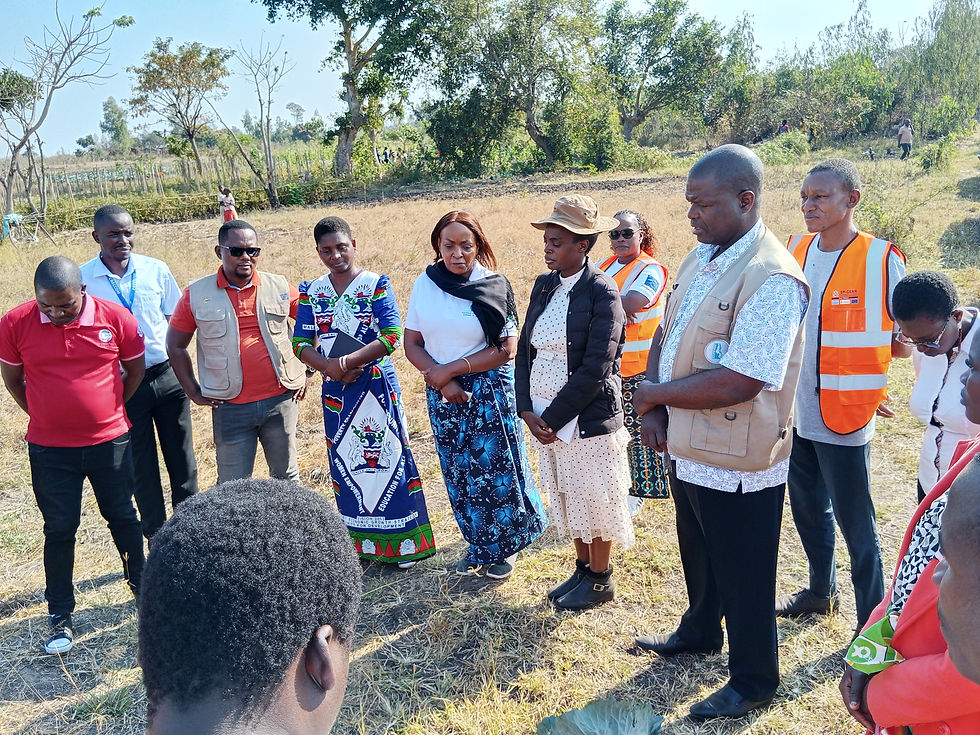
Acting Director of Community and Social Services at Zomba District Council, Paul Simfukwe, remarked that the visit demonstrated the value of integrating social protection with economic empowerment.
"These households are proving that when beneficiaries receive the right combination of financial support, technical skills, and continuous mentorship, they can establish viable businesses and improve their own livelihoods."
CRECCOM Director of Programmes Levison Lijoni noted that the project's impact lies not only in the number of households supported but in the confidence and resilience beneficiaries have gained.
"SP-GEAR is showing that social protection can become a pathway to self-reliance. Households are building productive assets that will continue improving their lives long after the project".
Implemented across all Traditional Authorities in Zomba District, as well as Mzimba North and Mzimba South, the SP-GEAR Project where CRECCOM supports Specific Objective Two; currently works with 640 Savings and Loan Groups and supports 960 Female-Led Enterprises, strengthening household resilience through business development, financial inclusion, and gender-transformative approaches.


Comments